
I've spent hours untangling mismatched API specs and codebases, and I'm guessing you have too. It's the kind of problem that sneaks up on you. A single outdated endpoint in the docs, and suddenly your team is debugging for days. When I first heard about tools like OOPS and Treblle, I wondered if they could actually save time or if they would just add another layer of complexity.
The promise here is straightforward: automate OpenAPI spec generation so your docs, SDKs, and tests stay in sync with your code. But the reality? These tools approach the problem in wildly different ways. Some scan source code, others monitor live traffic, and a few even parse legacy HTML docs. Each method has clear trade-offs, and picking the wrong one could mean wasted hours or worse, specs that still do not match your API.
This post digs into four tools: OOPS, Treblle, OASBuilder, and Speakeasy. It breaks down what they do well, where they fall short, and whether they are worth your team's time (or budget). If you have ever struggled to keep your API specs accurate, this one is for you.
Office Hours: AI-Powered OpenAPI Spec Generation
1. OOPS (OpenAI OpenAPI Project Scanner)
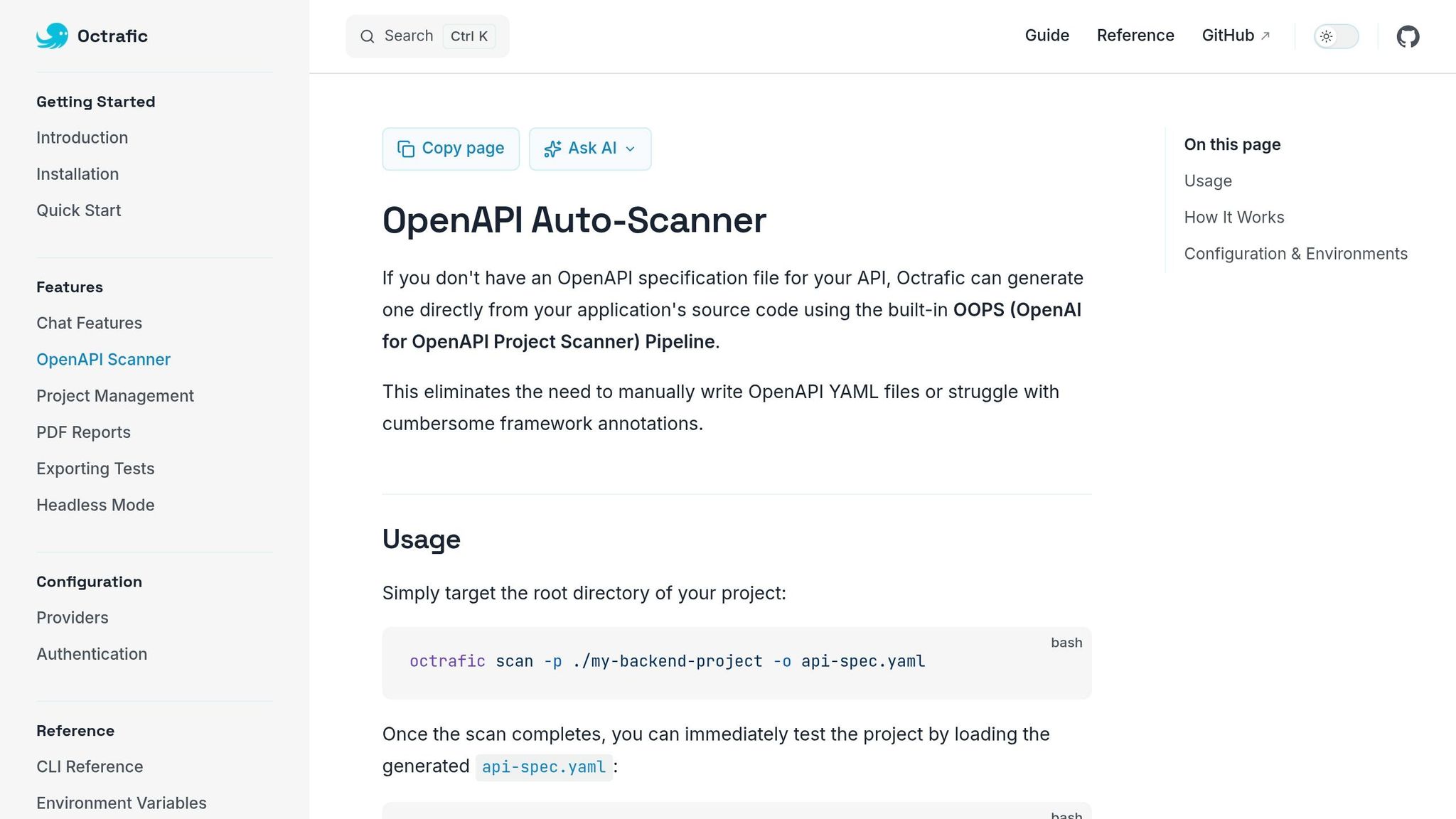
OOPS, developed by Octrafic, is an open-source utility designed to generate OpenAPI specifications straight from an application's source code. No need for manual YAML edits or framework-specific annotations.
Primary Input Source
OOPS begins by scanning the project root in four steps: identifying the programming language, locating routes, extracting endpoints, and compiling the final specification. It determines the language and framework by analyzing configuration files like go.mod, package.json, or requirements.txt. To keep token usage efficient, it skips over common directories.
The tool supports frameworks such as Go (net/http), Python (FastAPI), and Node.js (Express), making it a practical choice for developers working with these widely adopted environments.
OpenAPI Version Support
OOPS produces specifications in OpenAPI 3.1, available in YAML or JSON formats. However, it does not accommodate OpenAPI 2.0/Swagger or 3.0.x. For those older versions, you'll need a separate converter.
Strengths
OOPS uses parallel processing to isolate routing files, which helps control token costs. Its headless design makes it easy to integrate into CI/CD workflows. It also supports models like gpt-5-mini, gpt-5-nano, and claude-haiku-4.5.
Trade-offs
To use OOPS, you'll need an active LLM API key, and each scan generates token costs. Its heuristic-based approach to routing discovery means it might overlook endpoints in less conventional project structures. For accuracy, it's a good idea to validate the generated specification with tools like Swagger Editor.
2. Treblle
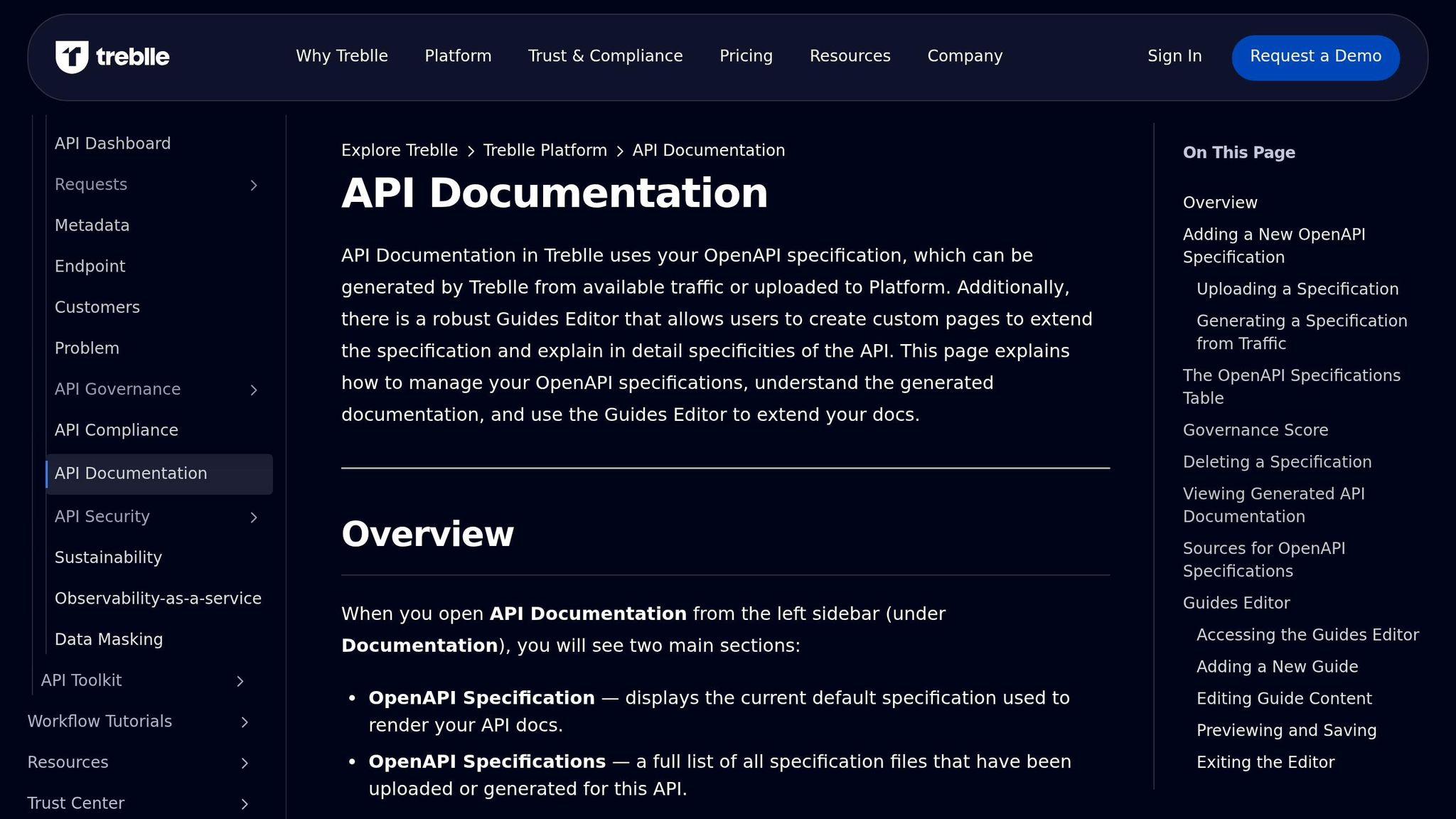
Treblle takes a different approach to API documentation by relying on live API traffic monitoring to generate specifications, avoiding the need to scan source code.
Primary Input Source
Treblle's standout feature is its ability to detect endpoints in real time from production traffic. This live update capability keeps documentation aligned with the actual behavior of your API, reducing the risk of documentation drift. It also supports manual uploads in JSON or YAML and integrates with CI/CD pipelines and API gateways. For local API testing and spec generation, the Aspen macOS app includes Alfred AI, which works without an external login. That is especially helpful for air-gapped or privacy-sensitive workflows. This setup allows Treblle to handle multiple specification versions in real time with minimal friction.
OpenAPI Version Support
Treblle supports OpenAPI Specification versions 2.0, 3.0, and 3.1. This flexibility is particularly useful if you are managing both legacy Swagger 2.0 specifications and newer 3.1 definitions, as it avoids forcing you into a migration.
Strengths
One of Treblle's standout features is Alfred AI, which can generate SDKs, integration code, and test cases directly from your API documentation. Treblle also assigns each specification a governance score (graded A to D on a 0 to 100 scale), evaluating factors like design rules, security, and compliance readiness. That gives teams a clear quality metric. The free tier is fairly generous, covering up to 250,000 API requests per month for 1 API and 1 workspace.
"Think of it as an extra engineer in your team who can answer all your API questions based on his knowledge of your APIs and your environment." - Treblle
Trade-offs
While Treblle offers a lot, it is not without drawbacks. The platform delivers the most value when deeply integrated into your tech stack. If you are only using it for documentation generation, the cost can feel steep. The Team plan runs $233 per month for 50 million requests across 10 APIs. Another limitation is that the Aspen AI features are macOS-exclusive, leaving Linux-based developers out of the loop. Treblle's focus on runtime observation also makes it less suitable for design-first workflows where specifications need to be created before any code is written.
3. OASBuilder
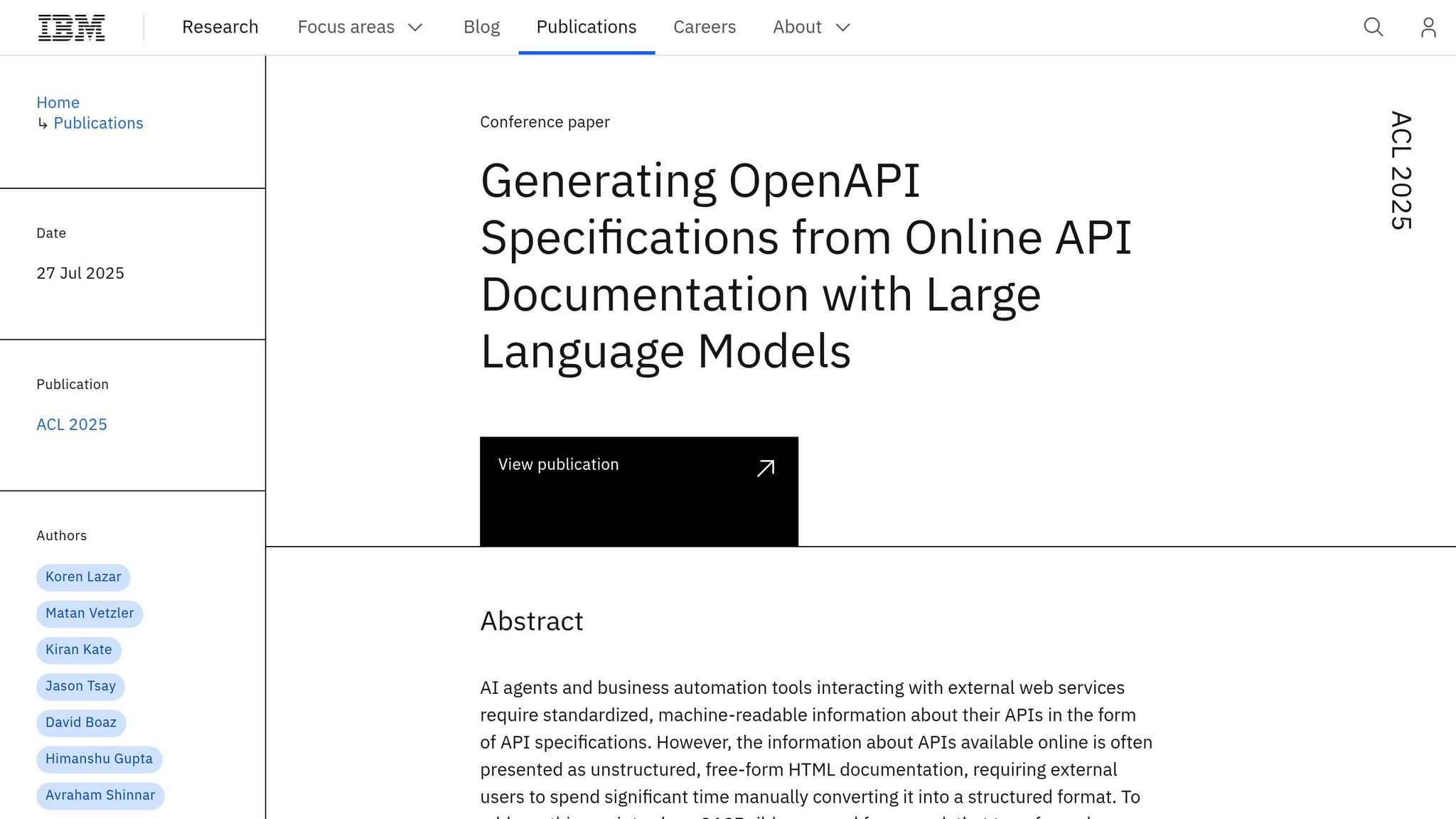
OASBuilder, developed by IBM Research, tackles a different challenge compared to traffic-based tools like Treblle. Instead of relying on API traffic, it generates OpenAPI specifications directly from legacy HTML documentation pages. This makes it particularly useful for APIs documented in static or dynamic HTML formats.
Primary Input Source
The tool processes unstructured HTML documentation to extract OpenAPI specifications. Its pipeline includes Selenium for scraping dynamic content and segmented LLM calls to handle large-scale HTML efficiently. Without this framework, raw HTML input to GPT-4-128K only resulted in valid OpenAPI specifications 25% of the time.
OpenAPI Version Support
While specific OpenAPI versions are not mentioned, the output is compliant with standard OpenAPI JSON formats and validated for use in LLM frameworks like LangChain. The tool also features a UI for manual review, allowing developers to verify generated parameters against the original documentation.
Strengths
OASBuilder has shown impressive results in tests across 291 documentation URLs. Key metrics include:
- 100% valid JSON output
- 89% valid OpenAPI specifications
- Minimal errors, averaging 0.17 errors per document
- High parameter precision at 0.96
Its ability to extract metadata efficiently reduces LLM calls for key fields by over 90%. For documentation not originally designed for machine parsing, these results stand out compared to source-scanning or traffic-based methods.
"OASBuilder has been successfully implemented in an enterprise environment, saving thousands of hours of manual effort and making hundreds of complex enterprise APIs accessible as tools for LLMs." - IBM Research
IBM has already put OASBuilder to work internally, generating specs for hundreds of APIs and integrating them into IBM Watson Orchestrate. This demonstrates its potential for teams managing legacy APIs documented only in HTML.
Trade-offs
The choice of model significantly impacts results. Valid OpenAPI specification rates vary widely, from 29% with llama-3 to 89% with codellama. This variability is a major consideration for production environments, especially when compared to the more consistent results of traffic-based or source-scanning tools. Another limitation is response schema generation, which struggles with deeply nested structures or sparse HTML documentation, leading to lower recall. Finally, OASBuilder's output is not production-ready. Human validation is necessary to ensure accuracy. Plan for a review phase to refine the generated specifications.
4. Speakeasy
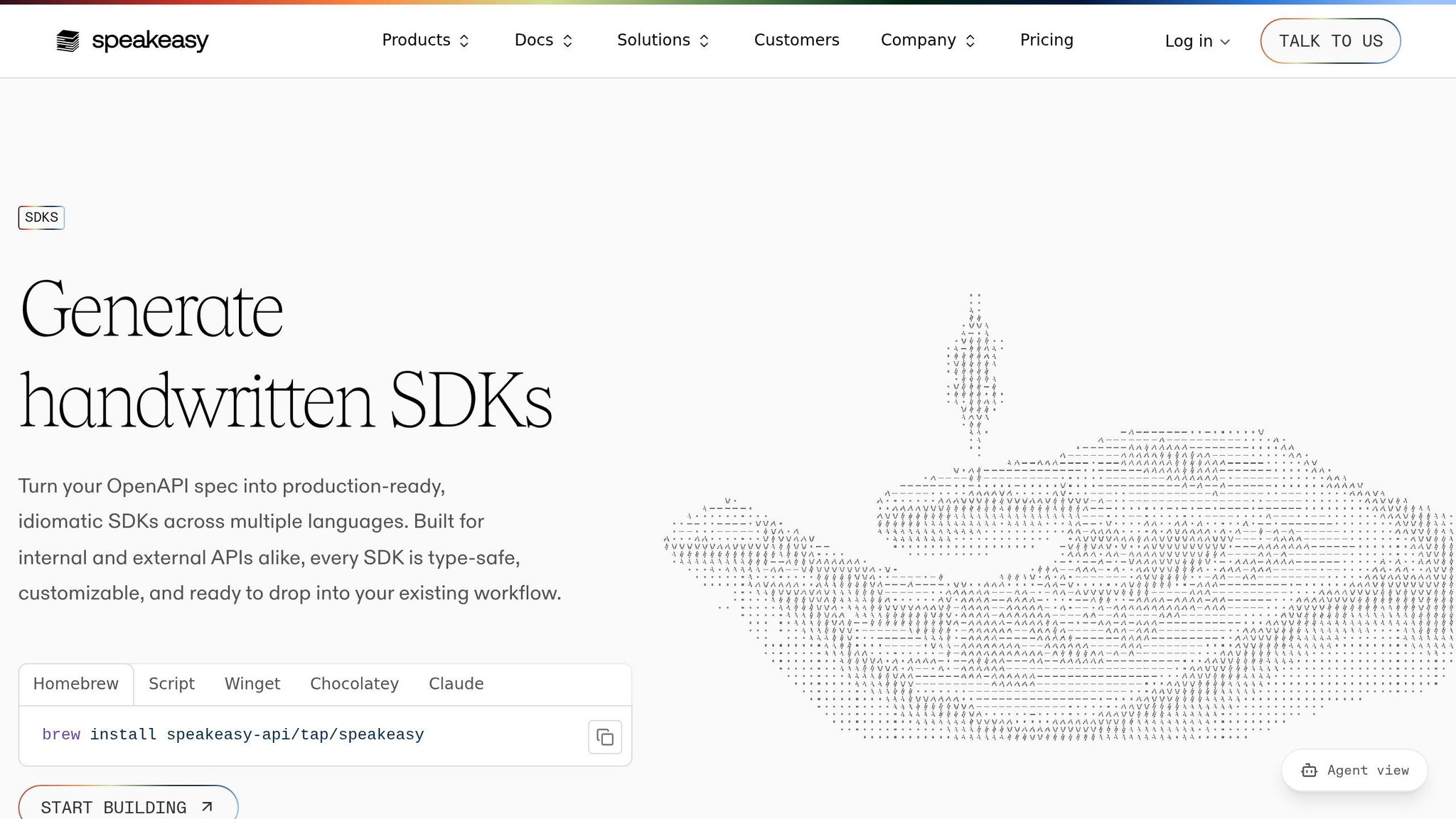
Speakeasy takes a different approach compared to tools like OASBuilder and Treblle. Instead of pulling specs from HTML docs or live traffic, Speakeasy starts with an existing OpenAPI document as its foundation. From there, it generates everything downstream, including SDKs, Terraform providers, MCP servers, and more.
Primary Input Source
Speakeasy works directly with OpenAPI 3.0 and 3.1 documents. For teams that prefer a code-first workflow, it integrates with tools like Zod, FastAPI, NestJS, and Pydantic. If your spec is not clean, you can apply OpenAPI Overlays to make non-destructive changes like stripping internal endpoints, renaming operations, or updating descriptions. The Speakeasy Suggest feature also scans for issues like missing operationId fields, inconsistent error types, or undocumented schemas, and proposes fixes automatically.
"Speakeasy Suggest provides automatic OpenAPI spec maintenance, helping teams move from messy specs to production-ready SDKs." - Speakeasy Blog
OpenAPI Version Support
Speakeasy supports OpenAPI 3.0 and 3.1 natively and can convert older Swagger (OpenAPI 2.0) specs using a dedicated CLI command. Unlike tools that rely on traffic or code as starting points, Speakeasy builds everything from the OpenAPI document itself.
Strengths
Speakeasy's reliance on OpenAPI documents as the source of truth has led to measurable results. Unified.to created six production-ready SDKs in just one week, saving $450,000 in development costs. ConductorOne saved 650 engineering hours, while Mistral AI scaled its API to millions of SDK downloads. Technically, its TypeScript SDKs have a smaller footprint, about three times smaller than those generated by Fern. The CLI is also lightweight, shipping as a standalone binary without requiring JVM or Docker, which simplifies CI/CD workflows.
Trade-offs
Speakeasy's language support spans 10 languages (TypeScript, Python, Go, Java, C#, PHP, Ruby, Kotlin, Unity, and Terraform), narrower than the 50+ offered by some open-source generators. Entry pricing starts at $600 per month per language, with a free tier covering one language and 250 endpoints. Advanced features like OAuth 2.0 support, React Hooks generation, and managed retries are only available in the paid tiers, which are designed for larger teams and projects. Enabling features like retry logic or pagination requires using Speakeasy-specific OpenAPI extensions (e.g., x-speakeasy-retries), introducing a degree of vendor lock-in. While the platform is SOC 2 Type II and ISO 27001 certified (important for enterprise clients), this does not directly impact day-to-day use.
Pros and Cons
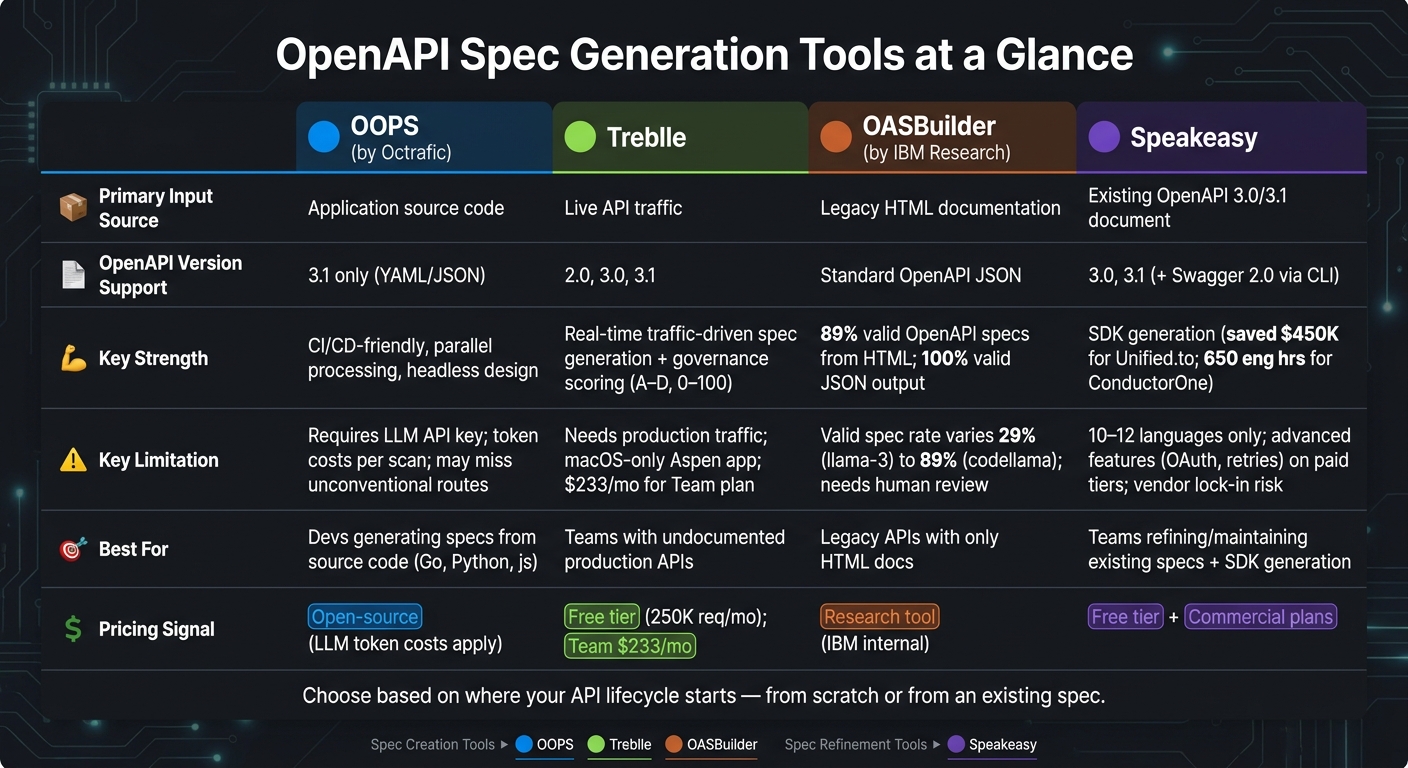
Choosing the right tool for your API workflow hinges on how your OpenAPI specification begins. The table below outlines the main trade-offs for each tool, helping you weigh their strengths and limitations.
| Tool | Primary Input | Key Strength | Key Limitation |
|---|---|---|---|
| OOPS | Application source code | Automated extraction of specifications from source code | Performance depends heavily on the quality and consistency of the source code |
| Treblle | Live API traffic + SDK instrumentation | Real-time, traffic-driven spec generation using API intelligence | Requires production traffic. Endpoints not accessed during capture may be excluded |
| OASBuilder | Legacy HTML documentation | Simple spec generation for teams without an existing spec baseline | Struggles to scale for generating comprehensive downstream services |
| Speakeasy | Existing OpenAPI 3.0/3.1 document | Effective spec maintenance with strong downstream SDK generation | Limited language support (10 languages vs 50+ in some open-source tools); advanced features tied to commercial plans |
The table captures the core trade-offs, emphasizing how each tool fits specific workflows. The biggest distinction lies between tools designed to create a specification from scratch and those focused on refining and enhancing an existing one. OOPS, Treblle, and OASBuilder are geared toward generating specs from the ground up, while Speakeasy specializes in improving and maintaining existing specifications.
For example, Treblle's traffic-driven approach is particularly effective for teams managing APIs that lack documentation. By leveraging live data, it keeps spec accuracy high, though it does depend on comprehensive production traffic to fully map endpoints.
On the other hand, Speakeasy shines in maintaining and refining existing specs. Its "Suggest" feature identifies and proposes fixes for issues like missing operationId fields, inconsistent error schemas, or undocumented responses. This makes it a strong choice for teams focused on upkeep rather than initial spec creation, but it is worth noting that it targets a different set of challenges.
Cost considerations also vary. Speakeasy offers a free tier alongside scalable commercial plans, while other tools may reduce upfront engineering effort at lower entry tiers. Understanding these trade-offs ensures you select a tool that aligns with your team's specific workflow and priorities.
Wrapping Up
No single tool handles every aspect of the API lifecycle. Tools like Treblle and Speakeasy address different needs. Treblle focuses on capturing endpoints from live traffic, while Speakeasy helps refine and maintain existing API specifications. The right choice depends heavily on where your API currently stands.
For production APIs without formal documentation, traffic-driven tools like Treblle can provide a clear view of real-world usage patterns. If your API spec is out of sync, Speakeasy offers features to restore accuracy and simplify downstream tasks like SDK generation.
It is also worth paying attention to independent reviews, which often reveal practical challenges that vendor materials gloss over. For example, issues like hallucinated endpoints or complications with CI/CD integration frequently show up in third-party evaluations, including those from R2clickthrough. Comparing vendor claims with these reviews can help you avoid unnecessary headaches. Choosing a tool that produces reliable, usable documentation upfront could save you days of rework later.
FAQs
Which tool fits code-first vs design-first APIs?
Code-first tools, such as OpenAPI Generator, specialize in automating the creation of SDKs, server stubs, and documentation directly from existing API specifications. These tools shorten the path from spec to code. Design-first tools like Swagger and Stoplight emphasize visual API modeling and validation, making them a better fit for defining and refining APIs before any implementation begins. Some tools, like Claude API, cater to both approaches but shine when used for design-first documentation.
How do I avoid missing endpoints in traffic-based specs?
To make sure no endpoints are overlooked in traffic-based OpenAPI specifications, consider using AI-driven tools that can generate thorough, validated specs directly from endpoint lists or source code. Tools that track API schema changes and automatically update documentation are particularly useful for maintaining accuracy. For spotting differences between spec versions, validation tools like openapi-diff can be invaluable. By routinely reviewing your specifications with these resources, you can ensure every endpoint is properly captured and documented.
How do I validate and clean AI-generated OpenAPI specs?
To check and refine AI-generated OpenAPI specs, tools like Vacuum or Spectral are your go-to options. Start by running the linter on your spec file, whether it is in YAML or JSON format. These tools will flag errors and warnings, pointing out areas that deviate from OpenAPI standards. You can address the issues manually or automate fixes using scripts. Keep running the linter until all errors are resolved, ensuring the spec is fully compliant and ready for deployment.
Comments